


5 Insurance Industry Trends From Insurtech Insights USA 2026.
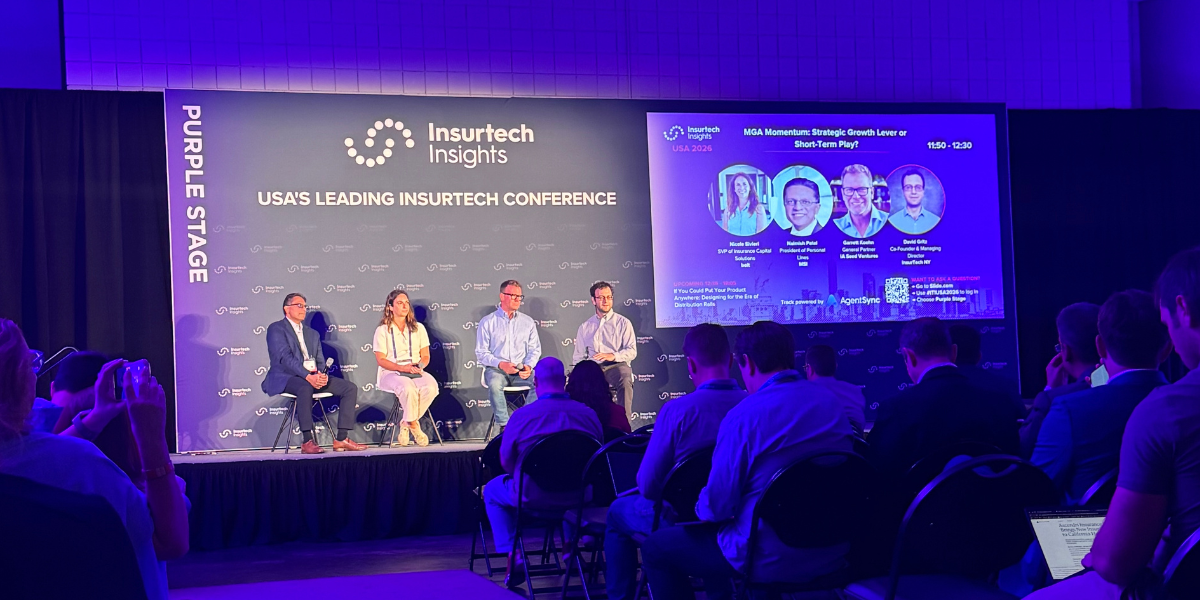
Insurtech Insights isn't a conference where people show up to repeat what everyone already knows. It's where founders, carriers, MGAs, investors and technology leaders come together to talk about what's actually happening in the insurance industry, and where it's headed.
As an official media partner, Caliber was onsite at the Javits Center for Insurtech Insights USA 2026 — and this year, a few insurance industry trends came through loud and clear.
1. As the protection gap widens, new growth opportunities are emerging
The industry’s protection gap continues to widen.
As risks become more complex — whether driven by climate events, economic uncertainty or changing consumer needs — the industry is struggling to keep pace. However, many leaders weren’t talking about the protection gap solely as a challenge, but as one of the biggest opportunities in insurance.
In a panel titled MGA Momentum: Strategic Growth Lever or Short-Term Play? Nicole Sivieri, Senior VP of Insurance Capital Solutions at bolt, made the case that when you look at the protection gap globally, the opportunity is actually larger outside the U.S. than within, explaining that emerging markets, particularly in rapidly evolving sectors like mobility, are where some of the most significant coverage gaps — and growth runways — exist right now.
2. The AI conversation has shifted
No surprise that AI showed up everywhere at the conference (when isn’t it?). What felt different was how practical the conversation had become. The question is no longer whether AI will impact insurance. It’s how organizations are actually using it.
The reality is that the insurance industry has a talent problem. Agencies and carriers are struggling to hire, and college graduates aren’t exactly lining up for careers in the space. That challenge is especially visible in excess & surplus (E&S), where highly customized coverage has created fragmented data and heavily manual, document-driven workflows.
As Chad Nitschke, General Manager of E&S at MGT Insurance, noted in Killing the ACCORD: How AI is Eating Insurance’s Paper Problem, these remain core friction points despite growing AI adoption. For this reason, many leaders see AI not as a replacement for people, but as a way to help existing teams work more effectively.
That means reducing the administrative work nobody enjoys — data entry, repetitive tasks and manual processes — so employees can devote more time to customer relationships, business development and strategic work.
The sessions also drew a useful distinction between defensive and offensive AI strategies. Defensive applications focus on efficiency and cost reduction. Offensive ones focus on growth, personalization and identifying underserved markets.
Both matter. But many of the most interesting conversations focused on the offensive: how AI can help organizations create new opportunities rather than simply do existing work faster.
Federato CEO and Co-Founder, Will Ross, pointed out that many insurers aren’t using AI to reduce underwriting teams. Instead, he explained in Scaling Commercial Property Through Relationship-Driven Underwriting, they’re using it to help existing teams process more submissions, accelerate decision-making and focus on the work where judgment and relationships matter most.
The consistent advice across sessions was to start small. Rather than trying to transform an entire department overnight, identify a specific pain point, involve the people closest to the problem and build from there.
3. The customer experience still has room for improvement
For all the progress happening across insurance, customer experience remains a challenge.
Part of that comes down to the complexity of insurance itself. A single policy can involve carriers, agencies, MGAs, reinsurers, data providers and technology vendors. Creating a seamless experience across that ecosystem isn’t easy.
As a result, many organizations continue to struggle with disconnected workflows, fragmented systems and handoffs that create friction for customers. That’s why the conversations at Insurtech Insights were primarily focused on creating better-connected experiences.
The common theme was that companies should start with the customer journey and work backward. From prospecting and quoting to placement, servicing and renewal, every touchpoint should feel connected rather than operating as a series of separate transactions. Without integration across the broader customer journey, even the most sophisticated tools can create unnecessary complexity.
4. Prevention is becoming as important as protection
Historically, insurance has focused on helping customers recover after losses occur. Increasingly, however, companies are focusing on helping prevent these losses from happening in the first place, aided by advances in data, connected workflows and real-time insights, which make this way of thinking possible.
This came through most clearly in discussions on catastrophe coverage, where prevention-first models are generating some of the most interesting conversations in the market right now, particularly around California wildfires. The logic is straightforward: claims you prevent drive down loss costs, and a customer who avoids a loss has a fundamentally better experience than one who has to file a claim.
That shift, from paying losses to helping customers avoid them, is changing how the industry thinks about the role insurance plays in people’s lives. Fewer disruptions for customers, better underwriting outcomes for carriers and programs. In high-risk categories like wildfire, it’s also becoming a competitive distinction.
5. People and data are still your biggest assets
Across sessions, the conversation kept coming back to the same two differentiators: people and data. The organizations building for the long term are investing in strong teams, making smart use of data and staying close to their customers.
In Ask bolttech Anything, Rob Schimek, Group CEO bolttech Group CEO, emphasized the value of hiring folks who demonstrate emotional intelligence. Technical expertise matters, but so does the ability to build trust, communicate effectively and lead through change.
As AI continues to reshape the industry, those skills may become even more important.

Rob Schimek, Group CEO of bolttech, sits down for a discussion with Isha Marathe of The Insurer.
Where the industry is headed
What stood out most at Insurtech Insights 2026 was the focus on operational reality.
The industry has a clear-eyed understanding of its biggest challenges: closing the protection gap, improving customer experiences, addressing workforce constraints and adapting to new risks.
The opportunities are real, the technology exists and the capital is there. Furthermore, the companies presenting at events like this are the ones already implementing the work.
That’s what makes Insurtech Insights one of the most important stages in insurance. Showing up, though, is just the entry point. What you get out of it comes down to intent — which conversations you seek out, how you show up as a brand and what you do to extend the impact beyond the event.
With the spring conference season now behind us, the industry’s attention is already turning toward fall. If you’re thinking what conference to attend next, check out our H2 conference guide.
And if conference strategy is part of your marketing and communications plan, we can help you think through where to show up and how to make the most of it. Let’s talk!
SHARE


Up Next.
How to Capture an Executive’s Voice on the Page.
Read More