



What to Expect at Money20/20 USA 2026: 8 Themes Shaping How Money Moves.
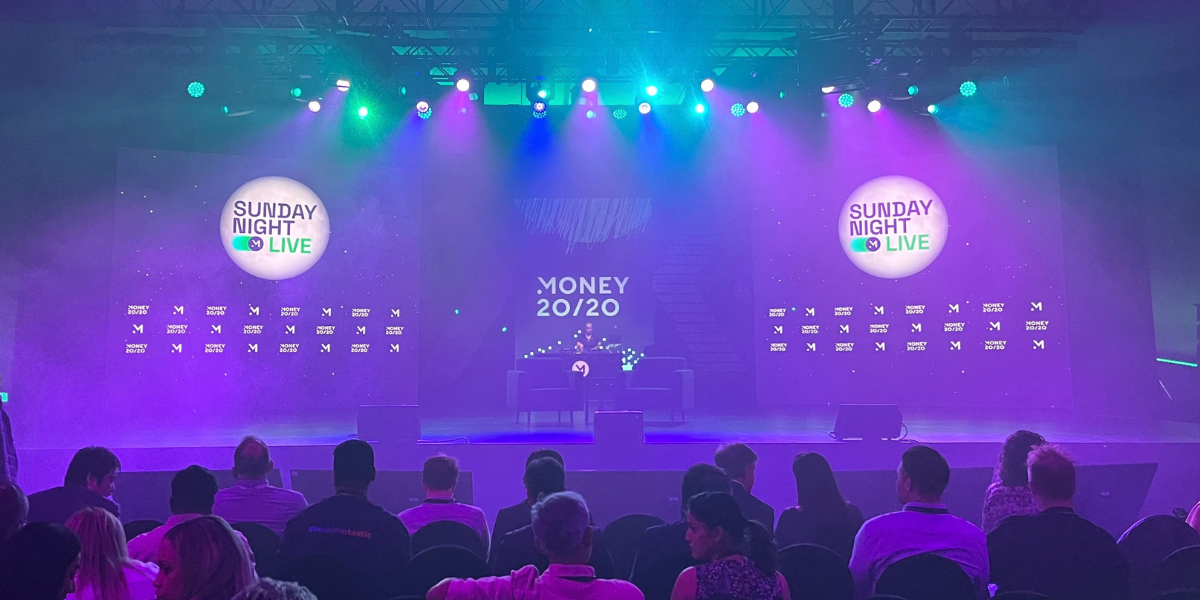
Money20/20 USA returns to The Venetian in Las Vegas October 18–21, bringing together 11,000+ attendees from 85+ countries and 630+ speakers for the biggest week on the fintech calendar.
This year’s agenda is organized around four content pillars, which Money20/20 describes as a reflection of where the industry is already heading rather than predictions:
- Borderless Financial Architecture
- Technology as the Great Equalizer
- Partnerships as the Engine to Scale
- Brave New World: Setting Guardrails
The sessions bear that out, with a focus on how banks, payments companies and fintechs are putting stablecoins, AI agents and new partnership models to work, and on the rules taking shape around them.
As a Money20/20 USA media partner, Caliber will be on site all week, meeting with clients, partners and press, and hosting everyone’s favorite invite-only happy hour: Fin & Juice.
So what should you be watching for at Money20/20 USA 2026? Here, we’re looking at eight themes that stand out across this year’s agenda.
Haven’t registered yet? Use code CAL250 at checkout to save $250 on your pass.
1. AI agents are starting to make payments
Payments are Money20/20’s core subject, and this year AI is being asked to take on a bigger part of the job. Instead of just answering a question or flagging a suspicious transaction, the agents on this year’s agenda compare options, complete purchases and move money on a customer’s behalf.
That shift sits at the center of the Technology as the Great Equalizer pillar, which pairs agentic AI with digital identity and trust. Those last two aren’t an afterthought. Before an agent can pay for something, the merchant, the bank and the card network all need to know who authorized it, what it’s allowed to do, and who’s on the hook if it goes wrong.
Money20/20 Europe 2026 offered a preview of where this is headed. AI and agentic governance topped the agenda in Amsterdam in June, and Forrester’s read coming out of that show was that AI already works on a technical standpoint, but most companies have yet to turn it into real business value. Las Vegas looks positioned to pick up that thread, with sessions leaning toward deployment, permissions and liability rather than demos.
The format is also changing alongside the subject matter. Money20/20 is adding workshops this year: immersive three- to four-hour deep dives into topics like AI and payments, with breakout discussions built in so implementation questions get more room than a typical panel allows.
Sessions to watch:
- Who Let the Bots Pay? The Missing Guardrails of Agentic Commerce
- Wiring the Agent Economy: Infrastructure for Trustworthy Agentic Commerce
- Agentic Commerce: A Payments and Infrastructure Reality Check
- Beyond Better Software: How AI Changes What Neobanks Can Build, Offer and Automate
- The Intelligence Layer: How AI Is Rewiring Financial Services
- When AI Agents Buy: Trust, Control, and Accountability in Commerce
- Is Acting a Responsibility Too Far for Agents?
2. Digital assets are moving into regulated finance
Stablecoins have been one of Money20/20’s biggest storylines since last year’s show, when Western Union announced plans for its own U.S. dollar stablecoin. This year, the federal rules are close to final.
The GENIUS Act, signed in July 2025, created the first federal framework for payment stablecoins, and regulators are now writing the rules to put it into practice. The Treasury Department has proposed rules on how payment stablecoins can be issued, offered and sold in the U.S., and its comment period closes October 19, the Monday of Money20/20. The Office of the Comptroller of the Currency has said it’s aiming for a final rule by November.
That timing will put banks, payments companies and fintechs in the same room while questions like reserve requirements and how stablecoins connect with existing payment systems are still being worked out.
Much of that conversation will happen at The Intersection, Money20/20’s dedicated space where traditional finance and digital assets meet, which returns this year in an expanded area with its own stage. Swift, the messaging network most banks use for international transfers, is well represented, alongside voices like former Commodity Futures Trading Commission Chairman J. Christopher Giancarlo and Fireblocks CEO Michael Shaulov.
However, stablecoins aren’t the only digital asset on the agenda. Tokenized real-world assets and even physical gold are getting their own sessions this year, with speakers from J.P. Morgan and the World Gold Council among those on stage.
For banks and asset managers, expect the discussion to focus on practical choices: custody, tokenized products, partnerships or building their own infrastructure.
Sessions to watch:
- It’s Not About Disruption Anymore, It’s About Coordination
- From Hill to Household: CryptoDad & Cryptomommi on Mainstreaming Money
- How Investment Institutions Are Adopting RWAs (Without Revising Risk)
- Old Is Gold: Why the Precious Metal Is Moving On-Chain
3. Prediction markets are becoming market infrastructure
If it wasn’t obvious from the barrage of ads during Sunday football or the fact that odds are now attached to world events, prediction markets have moved well past their reputation as a crypto-adjacent curiosity.
Combined monthly volume on Kalshi and Polymarket alone has been running above $45 billion, according to The Block, and Money20/20 has given the category its own agenda topic this year, with sessions spanning three of the four content pillars, institutional adoption, market data and regulatory oversight among them.
Kalshi co-founder and CEO Tarek Mansour will headline the conversation with a keynote fireside chat on the wisdom of crowds, institutional adoption and regulatory oversight. Elsewhere on the agenda, a separate panel will put Robinhood alongside crypto-native platforms and venture firms like Blockchain Capital, showing how far the category has moved from crypto-only territory, even as regulators work to catch up.
Sessions to watch:
- Prediction Markets as Market Infrastructure: Why Crowds Beat Pundits
- Prediction Markets Are Growing Up in Public (So You Can Read the Data)
- Ante Up: Bets Are an Emerging Asset Class You Shouldn’t Ignore
4. Fraud losses are still climbing
Money20/20 named fraud among the headline topics when it released its first wave of 2026 sessions, and it cuts across the pillars, from AI-predicted fraud to trust and transparency.
Little surprise, considering consumers reported losing $15.9 billion to fraud in 2025, according to the Federal Trade Commission, a 27% jump from 2024. Two forces driving that climb? Faster payments leave less time to stop a bad transaction, and generative AI is making scams more convincing and cheaper to run.
As AI agents start making payments, fraud teams face a newer question: whether the software on the other end of a transaction is acting for a real customer, and who’s responsible when it isn’t. That’s the question Plaid’s fraud product marketing lead will take on directly, walking through what “proof of intent” looks like once financial management goes agentic.
Identity carries through the rest of the track, too, with speakers from Mastercard, Block, Microblink and PlayStation tackling identity verification and deepfakes. Additionally, a separate session will bring Plaid and Adyen back together to look at fighting fraud from AI-enabled attackers specifically. Expect digital identity to come up nearly as often as detection.
Sessions to watch:
- Criminals Ship Fast: Is Your Risk and Compliance Team?
- Attack of the Clones: Managing Identity in the Deepfake Era
- The New Questions Fraud Teams Need to Answer in Intelligent Finance
- How to Fight Fraud Perpetrated by an AI-Enabled Attacker
- Digital Identity Is Broken: States Have a Solution
5. Wealth management gets its own stage
Not everything at Money20/20 is about payments rails or crypto plumbing.
This year’s agenda includes a dedicated Family Office & WealthTech Summit, one of five Sunday Summits running October 18, and a speaker list drawing from HSBC, State Street, CIBC and Edward Jones signals real, high-net-worth-adjacent budget behind a track that doesn’t fit neatly into the AI, crypto or payments storylines dominating the rest of the agenda.
HSBC’s Racquel Oden will open the track with the number behind it all: $84 trillion is about to change hands over the next decade, moving toward younger generations, women and entrepreneurs who expect something different from the firms managing it.
The rest of the track digs into who that money actually moves to. Winning those clients now takes personalized, relationship-driven service, not just investment performance, as wealth shifts to younger, more diverse hands. There’s a harder side to that same transfer, too: the administrative and emotional burden of estate settlement, which falls overwhelmingly to daughters. And for family offices specifically, the stakes are relational as much as financial, in a referral-driven market, one bad client experience can cost a network built over years.
Sessions to watch:
- Money Is Moving. And So Should the People Who Manage It
- To Win Wealth Management, It Needs to Feel Like Luxury
- Winning Family Offices: Why Customer Experience Is Your Moat
- Her Burden, Her Grief, Her Estate: Unlocking Women’s Generational Wealth
6. Fintechs are scaling through partnerships
This year’s agenda gives the topic its own dedicated pillar, Partnerships as the Engine to Scale, covering fintech-as-a-service, embedded finance, and collaboration and investment across the industry.
In practice, that could mean a software company offering payments or lending through a bank partner, a bank selling its infrastructure to fintechs, or a startup entering a new market by working with local players. Banks are leaning into that last piece as much as anyone, too, with sessions from major payments banks on the agenda alongside the fintechs they’re courting.
Global expansion gets real attention, too, especially in Latin America, where Money20/20 is hosting a dedicated LATAM meetup alongside sessions on the agenda. At the Startup Hub, a pair of sessions looks at how young companies weigh building their own infrastructure against buying it, and how the right local partnerships can help them break into new regions faster than going it alone.
Sessions to watch:
- Build vs Buy? The Gameplan for Regional Expansion
- The Partnerships that Help Startups Unlock Markets
- Why Local Infrastructure Is Vital for Cross-Border Payments
- Part 1: Embedded Finance: Smarter, Faster, Higher Stakes
- Sponsor Banking at Scale: Driving Revenue Across the Lifecycle
7. Investors are writing fewer, bigger checks
Fintech funding is up, but it’s going to fewer companies. Investors put $28.6 billion into the sector globally in the first half of 2026, a 23% jump year over year, even as the number of deals fell by about a quarter, according to Crunchbase data.
Investors are concentrating on financial infrastructure, wealth management and enterprise automation, with AI driving much of the interest. At the same time, conviction is building in a very different direction: crypto, increasingly pitched not as a side bet but as the infrastructure consumer fintech runs on.
With capital concentrating into fewer deals, getting in front of the right investor matters more than it used to. That’s what the Startup Hub and pitch competition are built for, and a dedicated investor pass means plenty of investors will actually be in the building.
And the agenda isn’t the only place deals and conversations happen. The week is stacked with happy hours, dinners and after-parties, and some of the best relationship-building happens well outside the sessions. Money2020Parties.com is a good place to start scouting what’s out there.
Sessions to watch:
- Fintech Funding in the AI Era: What Investors Actually Want
- A Tale of Two Investments: Retail Investing Versus Venture Capital
- Goodbye TradFi: Crypto Is the Future of Consumer Fintech
8. AI and data rules are still unsettled
Stablecoins may be getting a rulebook, but much of fintech is still waiting on one. Money20/20’s Brave New World: Setting Guardrails pillar makes the point directly, covering regulatory uncertainty not only for digital assets but also for large-scale AI adoption, data use and how financial institutions are supervised.
The pillar’s discussion points include how supervision should work, transparency and access to data, and how regulators across sectors can align. Open banking and data-sharing rules sit squarely inside that conversation, alongside where crypto policy stands after the CLARITY Act’s introduction.
For companies building with AI, the practical questions are about explainability, data use and what examiners will expect, and many of those answers are still being worked out.
Sessions to watch:
- A View From the FDIC: The Future of Financial Innovation
- CLARITY Act or Ambiguity: The Bill Redrawing the Financial Map
- The Data Flows That’ll Allow You to Bank More “High-Risk” Businesses
- Alt Open Banking: Data Sharing Done Differently
Where to network after hours
Of course, the official event agenda is only part of the week. Plenty of companies host their own receptions, dinners, happy hours and even run clubs around the show.
Money2020Parties.com is a running list of the events happening around Money20/20, sorted by day with a link to request an invitation for each one. It’s updated as events are announced and submitted, so check back as the show gets closer.
Hosting your own Money20/20 party? Promote it on Money2020Parties.com.
Fin & Juice has become one of Money20/20’s go-to happy hours, and it’s back again this year. Hosted with The Financial Revolutionist and Grasshopper Bank, it runs Sunday, Oct. 18, from 7 to 9 p.m. at Cañonita in The Venetian, right after Sunday Night Live wraps. Expect a curated crowd of banks, fintechs, investors and media over drinks and food. It’s invite-only, so request yours early.

Planning your time in Vegas
Know what you’re prioritizing. Meetings, partnerships, investor conversations and staying current on the market all call for different schedules. If it’s your first show, don’t skip Sunday, the summits, Sunday Night Live and the first-timers networking session are worth being there for. If you’re in marketing or comms, Wednesday morning’s deep dives are worth sticking around for, including a session on explaining complex financial products in plain language.
Book meetings early, too. Roughly one in three attendees holds a C-suite title, and both Sm∆rtMeet‘s pre-scheduled matching and the Money20/20 Connect app’s self-booked meetings fill up fast with that many senior decision-makers in the building.
For more on getting value from a conference, check out our insider’s guide to maximizing your conference experience.
And if you haven’t registered yet, there’s still time to save $250 off registration using the code CAL250.
Making the most of Money20/20 USA 2026
Money20/20 packs a lot into four days, and the best plan is one built around what matters most to your business, not how many sessions you can fit into a calendar. Pick the conversations you need to be part of, leave room for the people you want to meet and stay flexible.
Caliber will be on site throughout the week as an official Money20/20 USA media partner.
If you’re looking to build on the momentum from Money20/20 and other industry moments as part of a broader PR and marketing strategy, let’s connect.
SHARE


